

Hairstyles Guide: Finding Cuts and Styles That Work for Your Hair
Table of Contents
You know the feeling. A photo saved months ago, a stylist who nodded along, and then a mirror at home telling a slightly different story. Nobody warns you about the gap between the picture and the person wearing the cut.
Most of the time the haircut itself was fine. It just wasn’t chosen with your hair in mind. Texture, thickness, density and the way your strands fall on their own all push a style in one direction or another, and a photo tells you none of that.
So this guide starts with your hair, not the cut. Read that part right and choosing gets much less like guessing.
Not sure what your texture even is? The Hair Type Quiz and Hair Texture Test take a couple of minutes, and they’re worth doing before you go on.
Why the Same Haircut Looks Different on Everyone
Put a blunt bob on fine, straight hair and it looks sharp, almost architectural. Put the same bob on thick, wavy hair and you can end up with a triangle, because all that volume sits at the jaw and pushes outward. Same scissors, same length, different hair. Nobody did anything wrong.
Three things do most of the deciding. Texture, meaning straight, wavy, curly or coily, sets how hair falls and where it wants to sit. Density is how much hair grows per square inch of scalp, and it controls how much volume a cut can carry. Porosity gets less attention, but it shapes how your hair reacts to humidity and product, so it has a say in whether the style makes it to evening.
Take the reference photo to your stylist, sure. Treat it as a rough silhouette. If the person in it has a different texture from yours, your result will drift from the picture, and that’s normal.

Cuts and Styles by Hair Type
Straight hair shows everything. Every line, every layer, every slightly uneven edge, which is why precision cuts look so good on it: blunt bobs, sharp lobs, long layers. Flatness is the trade-off. Finer straight hair tends to look fuller with blunt lines and only light layering, while thicker straight hair often needs more layers to avoid feeling heavy. Care tips for this texture are in the Straight Hair Guide.
Wavy hair wants room. A cut that lets the pattern show (long layers, a shag, a lob with some movement) will flatter waves far more than a heavy one-length cut, which can drag the wave right out. Thicker waves may need a little texturizing so the ends don’t bulk up. The Wavy Hair Guide covers care and styling together.
Curly hair is a different job for the scissors. Curls shrink as they dry, so whoever cuts them has to plan for the spring-up, and it’s worth finding a stylist who does this regularly. Layers that follow the natural fall of the curl last longer and look better than a straight line across, which tends to finish as a triangle. That’s why curly bobs, shags and long layered cuts are so popular: each curl gets space instead of merging into a clump. More in the Curly Hair Guide.
Coily and 4C hair has the widest range of the four: tapered cuts, TWAs (teeny weeny afros), shoulder-length styles, and protective styles that cut down on daily handling and heat. Keep protective styles loose, though, since styles that pull tightly can cause traction hair loss (see our Hair Loss & Thinning Guide). Shrinkage is the big variable, far more dramatic than in other textures, so agree on length with your stylist in stretched terms. Dry length alone will mislead you. The Coily Hair Guide goes further on care.

Thinking About Density, Not Just Texture
Texture gets all the attention, but density changes the answer just as much. Two people with identical curl patterns can need entirely different cuts if one has fine, thin hair and the other has a heavy, dense head of it.
Fine hair, whatever its texture, generally looks fuller with blunt lines. Pile on layers and the ends can go wispy and see-through. A single length or very light layering gives the impression of more hair than is actually there.
Thick hair is the reverse. It needs layers to shed weight, particularly when it’s wavy or curly. Leave it in one blunt length and the pattern gets pulled straight by its own mass, so you get heavy instead of full. Thinning can help if it’s done with a light hand. Overdo it and you’ll be regretting it for months.
If you can’t tell where you sit, a stylist will spot it in seconds. Or hold your ponytail: thin, medium, or a proper handful.
Choosing a Style for Your Face Shape
Face shape advice is everywhere, and there’s something to it, but these are styling conventions rather than science, and they shouldn’t carry the whole decision.
Round faces look longer with a bit of height at the crown and length that falls past the chin, while cuts that add width at the cheeks work against that. Square faces soften with layers or waves near the jawline. Oval faces get the widest choice, since most lengths and cuts work. Long faces tend to suit waves or volume at the sides and a fringe, rather than very long, straight, centre-parted styles that stretch the face further. Heart-shaped faces, broader across the forehead and narrow at the chin, balance well with volume around the jaw or a chin-length style. Diamond faces, widest at the cheekbones, often suit volume or a fringe at the forehead and width at the jaw.
Treat all of that as a starting point. Plenty of people ignore every rule above and look great, usually because the cut suited their texture and their routine first.
Not sure what your face shape is? Try our Face Shape Hairstyle Finder.
Everyday Styling That Actually Works With Your Cut
A cut that needs twenty minutes and three tools every morning won’t survive a busy week. Worth thinking about before you sit down.
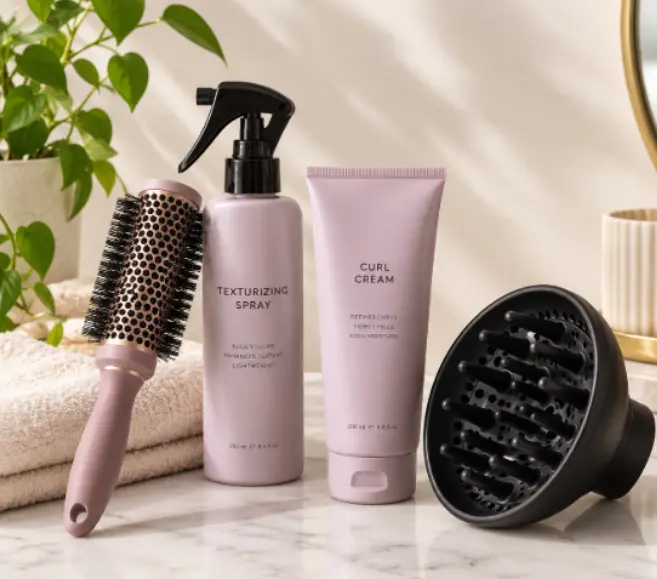
Straight hair holds its shape with a round brush while blow drying and a texturizing spray after. Waves do better when you scrunch product into soaking wet hair and then air dry or diffuse, since brushing smooths the pattern away. With curls, cream or gel goes on very wet hair, and after that it’s hands off until it’s dry. Hard to do, but it makes a real difference. Coily hair cares less about any single product than about moisture and gentle detangling, because dryness changes how the cut falls more than anything else.
Want a routine built around your type and your cut? The Hair Routine Builder will put one together.
Talking to Your Stylist So You Get What You Actually Want
Plenty of bad haircuts are really bad conversations. You nod, you smile, you pay, and only in the car do you think: that’s not what I asked for.
Photos help, but say how you’ll style it day to day as well. A cut designed for wash and go is not the same cut as one meant for a blow dryer each morning. Tell them how your hair behaves in real life, whether it goes oily by lunchtime, frizzes the second it’s humid, or does its own thing by afternoon.
Ask about upkeep before you commit. Some cuts want a trim every six weeks, others go three or four months. And if you’re growing your hair out, say so early and plainly. “Trim it” and “give me a new shape” sound alike at the chair and mean very different things.
Frequently Asked Questions
How do I know what haircut will suit my hair type?
Begin with texture (straight, wavy, curly, coily) and density (fine, medium, thick), because those two decide how a cut falls and behaves. A stylist who knows your texture can take it from there, and knowing the basics makes it easier to explain what you want.
Can I get the same haircut as someone with a different hair texture?
As a shape reference, yes. The result will look different on your hair, though, depending on your texture and density. A good stylist can often adjust the cut to suit you and keep the overall look you were after.
Should curly hair be cut wet or dry?
Many curl specialists cut dry, or dry after a first wet cut. Curls shrink and shift as they dry, and the stylist needs to see how each one really falls before shaping it.
How often should I get a haircut to maintain a style?
Depends on the cut. Precise, blunt styles often need a trim every four to six weeks to keep their shape. Looser, layered cuts can go three to four months.
Does face shape really matter when choosing a hairstyle?
It’s a useful guide, not a rule. Your texture, your density and how you want to style it each day usually count for more.
Final Thoughts
The best haircut is whichever one fits your texture, your density and the minutes you’ll really spend on it each morning. Get that right and most cuts will work. You also recognise yourself in the mirror afterward, which counts for a lot.
Ready to put it into practice? Our Hair Styling Guide covers the everyday techniques that keep a cut looking good.
