

Curly Hair Guide: Understanding Your Curl Type and How to Care for It
Table of Contents
Curly hair has a mind of its own. Some mornings it falls into these perfect ringlets without you doing a single thing differently. Then the next day, same shampoo, same product, same everything, and somehow it’s a frizzy cloud that barely resembles what you had going the day before. People treat “curly” like it’s one fixed look, but anyone who actually lives with curls knows it’s more of a range than a single thing.
So let’s actually get into it. What makes hair curl, the different curl types you’ll run into, and what tends to help depending on where you land on that range.
Not totally sure if what you’ve got is curly or leaning wavy? The Hair Type Quiz sorts that out in under a minute, no guessing required.
Why Does Hair Curl At All?
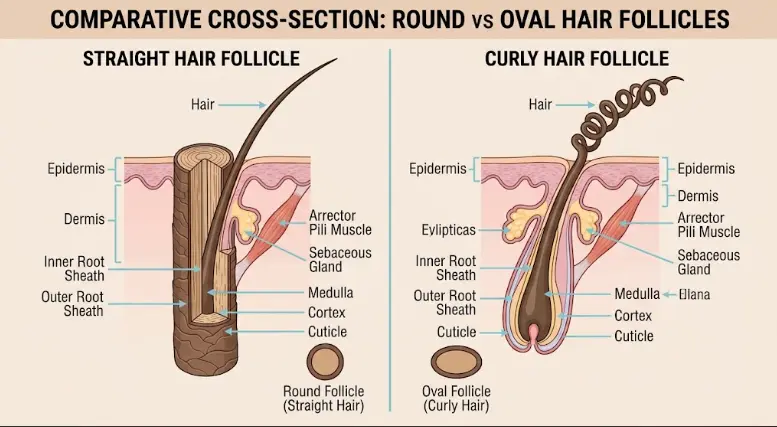
It starts in the follicle, the tiny pocket in your scalp that each hair grows from. Straighter follicles push hair out evenly, which gives you straight strands. Curved or asymmetrical follicles cause the hair to grow unevenly, which bends and coils it as it comes out.
Generally, the more curved the follicle, the tighter the curl. Curl type is a matter of degree, from barely-there waves all the way to tight, springy coils, and researchers have found that many genes are involved, so it’s more complicated than a single trait.
Genetics decides most of this. If curls run in your family, chances are you inherited the same follicle pattern. Ancestry plays a role too, and curl patterns vary across populations, but curls show up in people of every background.
The Curl Types: 3A, 3B, 3C
In the popular Andre Walker typing system, curly hair falls under Type 3, and, just like wavy hair, it’s split into sub-types that don’t always behave the same way. These are a styling shortcut rather than a medical classification, and many heads are a mix.
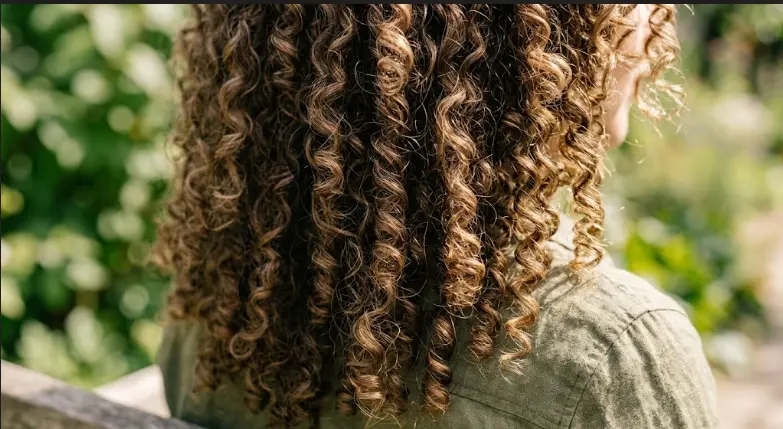
3A is the loosest of the bunch. Big, loose curls, almost like something you’d get out of a curling wand. Loose curls tend to look shiny, but they can also fall out of shape quickly, whether from humidity or the weight of longer hair pulling them down.
3B tightens things up. Springy, bouncy ringlets, more like a corkscrew than a spiral. Usually more volume than 3A, and it holds its shape better too, though it’s also drier, since oil has a harder time making its way down a curlier strand.
Then 3C, the tightest of the three. Corkscrew curls packed in close together, often the most voluminous of the group, and also the thirstiest. The tighter the curl, the harder it is for scalp oil to reach all the way to the ends.
This matters more than people think. A routine built for 3A will leave 3C hair dry and frustrated. A routine built for 3C will drown 3A curls in product they never needed.

Still not sure which one’s actually yours? The Hair Texture Test beats comparing your hair to random photos online.
So Where’s the Line Between Curly and Wavy?
This confuses a lot of people, especially anyone with looser 3A curls that can look wavy depending on the day. Generally, curly hair holds a proper coil or ring shape on its own. Wavy hair falls into more of a loose S shape and usually needs a nudge, product or technique, to look fully done.
Quick test. Scrunch a dry piece of hair in your palm. Springs back into a coil? Curly. Settles into a soft bend instead? You’re closer to wavy. Not foolproof, plenty of hair sits right on the border, but it’s a decent starting point.
What Comes With the Territory
Curly hair has a few traits that show up no matter which sub-type you’re dealing with.
The good part first. Curls bring volume and texture that straight hair just doesn’t have, and once you know your routine, a defined curl pattern can look incredible without much daily effort.
Now the annoying part. Curly hair often runs drier than straight or wavy hair, because the curl makes it harder for scalp oil to travel down the strand. Frizz shows up more too, especially in humidity. It shrinks noticeably once it dries, which makes judging length kind of a guessing game some days. And tangling is basically a given, since curls wrap around each other way more than straighter textures do.
Curious how your curls are actually doing underneath the shine? The Hair Health Score Calculator gives you something more honest than a glance in the mirror.
Habits That Quietly Work Against Curly Hair
A handful of habits keep showing up, and most people have no clue they’re the actual problem.
Brushing dry curls tops the list, easily. It doesn’t create definition, it just tears curls apart into frizz. Detangling belongs in the shower, wet hair, conditioner still in, fingers or a wide-tooth comb doing the work.
Washing too often is another one. Curly hair needs moisture more than most textures, so frequent washes with a harsh shampoo can strip the oils it’s already struggling to hold onto.
Then there’s skipping leave-in conditioner or styling product altogether, when curly hair usually needs more product than straight or wavy hair, not less.And the classic vigorous towel rub after a shower? It can rough up the cuticle and disturb the curl pattern before it’s had a chance to set.
A Routine That Actually Brings Out Definition
If your curls tend to land somewhere between frizzy and defined more often than you’d like, try this.
In the shower, reach for a moisture-rich conditioner. Detangle while it’s still in, fingers or wide-tooth comb, working from the ends up toward the roots. Rinse thoroughly, since leftover product can weigh curls down. A cooler final rinse feels nice if you like it, but the idea that cold water “seals” the cuticle isn’t well supported.
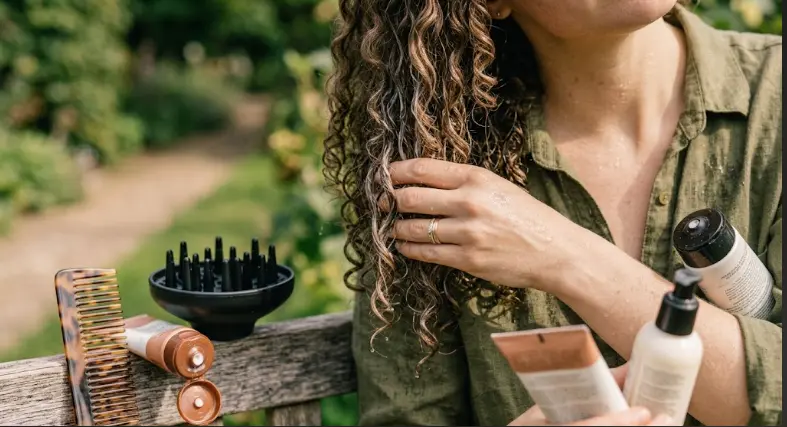
Once you’re out, apply leave-in conditioner and your styling product (curl cream or gel, whatever suits your type) while hair’s still soaking, not just damp. Curls hold product better with plenty of water still in there to help it spread.
Scrunch upward, don’t smooth it down, and then leave it completely alone until it’s dry. This is where a lot of people slip up. Touching curls while they’re drying is one of the fastest ways to end up with frizz instead of definition.
Diffusing? Keep the heat low, cup sections into the bowl instead of shaking things around too much. Once it’s dry, if you used gel and want to soften the crunch, scrunch it out gently with slightly damp hands.
Guessing which products actually suit your curl type and porosity gets old fast. The Hair Product Finder skips that part for you.
Porosity Matters More Here Than With Almost Any Other Texture
Here’s something that gets skipped constantly: porosity, basically how well your hair takes in and holds onto moisture. It matters a lot for curly hair specifically, since curls are already fighting dryness by nature, and porosity ends up deciding which products and techniques will actually do anything for you.
Low porosity curly hair tends to resist moisture and often does better with lighter products on damp hair, and some people find a bit of gentle warmth, like a warm towel, helps products absorb. High porosity curly hair soaks up moisture fast but loses it just as quickly, so it usually does better with richer creams and sealing oils. Some people also add the occasional protein treatment, though the research on them is limited.
Never actually tested this and just been winging it? The Hair Porosity Test takes a couple of minutes and can shift your entire approach.
Frequently Asked Questions
What are the different curly hair types?
In the popular Andre Walker typing system, curly hair falls under Type 3: 3A (loose, spiral curls), 3B (tighter, springy ringlets), and 3C (tightly packed corkscrew curls with the most volume of the three). It’s a styling shortcut, so many people are a mix.
How do I know if my hair is curly or wavy?
Scrunch a dry piece of hair in your palm. Springs back into a coil or ring? Curly. Falls into a soft, loose bend instead? Closer to wavy.
Why is curly hair so much drier than other hair types?
Often because of the curl itself. Scalp oil has a harder time travelling down a bent, coiled strand than a straight one, and tighter curls make that trip even harder.
How often should curly hair be washed?
Once or twice a week works for many people, with a gentle, moisture-rich shampoo. Go by your scalp: wash sooner if it feels oily or itchy. Washing more often than you need with a harsh shampoo can strip oils curls rely on.
Should I brush curly hair when it’s dry?
No. It breaks up the curl pattern and creates frizz almost instantly. Stick to detangling wet hair with conditioner still in, using fingers or a wide-tooth comb.
Does curl pattern change over time?
A little, sometimes, thanks to hormones, damage, or age, but a full switch to a different curl type is rare. Usually what changes is how defined the curls look, which comes down to how the hair’s actually being treated.
Final Thoughts
Curly hair isn’t hard to deal with. It’s just specific. Once you actually know which curl type you’re working with, and factor in porosity instead of ignoring it, most of the trial and error disappears and things start feeling a lot more predictable.
Want to see how curly stacks up against its tighter, coilier cousin? Our Coily Hair Guide gets into that comparison properly. And if you’re tracking how much length you’ve gained lately, the Hair Growth Calculator is a simple way to keep tabs on it.
Sources
This article is for general education and isn’t medical advice. It draws on the following sources:
- The biology and genetics of curly hair – Experimental Dermatology (Westgate et al., 2017)
- The Genomic Variation in Textured Hair: Implications in Developing a Holistic Hair Care Routine – Cosmetics (MDPI)
- Tips for healthy hair – American Academy of Dermatology
- Andre Walker Hair Typing System – Wikipedia
