Dandruff vs Dry Scalp:How to Tell Which One You Have
Table of Contents
Flakes on your shoulders? Let’s sort out which one it is — and what to actually try first.
Dark top. Bathroom mirror. Flakes everywhere.
You know that moment. You brush them off, they come back. You grab whatever shampoo says “anti-dandruff” on it, use it a week, and… nothing. Or it gets worse — drier, itchier, still flaky. Fun.
Here’s the thing nobody tells you: dandruff and dry scalp look the same from across the room. Up close? Different story. Different cause. Different fix. Get the wrong one and you can spend months going in circles.
So let’s not guess. Let’s look. Want a faster read? Try our Dandruff or Dry Scalp Quiz.
| If you’re in a hurry, this is the gistDry scalp: tiny, dry, white, powdery flakes. They fall — onto your shoulders, your desk, everywhere. Skin elsewhere is often dry too. The scalp may feel tight after a hot shower, and it can get worse when the air is cold and dry.Dandruff: bigger, yellowish, oily flakes. They cling rather than fall. The scalp may feel oily, itchy, or coated between washes. Dandruff is tied to a yeast called Malassezia — everyone has it — and sits on the seborrheic dermatitis spectrum.Colour alone? Don’t trust it. Redness looks different across skin tones. Texture, where the flakes sit, and whether the flaking stays on the scalp or travels beyond it are more useful clues. |

Okay, mirror time. What are you actually looking at?
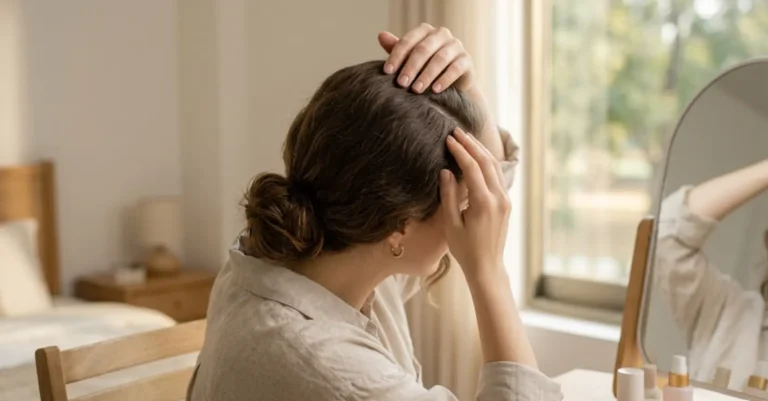
Good light. Part your hair in a couple of places. Don’t scratch — just look. Feel.
First, the flakes themselves. Dry-scalp flakes are usually small, dry, and powdery. They fall. Dandruff flakes tend to be bigger, yellowish, a bit oily, or sticky. They cling to the scalp and hair. Honestly, that fall-versus-cling difference alone tells you a lot.
Then, how does the scalp feel? Tight and dry after washing leans toward dry scalp. Oily, itchy, with that “I need to wash this again already” feeling? That leans toward dandruff.
Then — and people skip this — look past the hairline. Check the eyebrows, the sides of the nose, behind the ears, and the chest. Flaky, itchy patches there? That leans more toward seborrheic dermatitis than simple dry scalp.
And look at the rest of your skin. Dry shins? Dry hands? A face that flakes in winter? If the rest of you is dry too, dry scalp fits better.
Could it be both? If your scalp sits somewhere in the middle, the quiz has a “could be either” result with a gentle first-week plan. Yes. That happens. A dry scalp can sit right alongside dandruff. Don’t panic about it. Pick the pattern that fits best, try that first step, and give it a real trial. Bouncing between shampoos every two days tells you nothing.
If it’s dry scalp, be gentler — not stronger
Dry scalp is usually about dryness or irritation: harsh washing, hot water, dry air. Not yeast. So stronger shampoo isn’t the answer. Kinder is.
Use a mild shampoo. Focus on the scalp, and don’t scrub like you’re trying to win something. Don’t over-clarify. Conditioner belongs on the lengths — mid-lengths to ends — rather than in a big glob on the scalp.
Hot water? Turn it down a notch. High dryer heat? Same. Use warm water, lower the dryer setting, and keep it moving. Your scalp may feel less tight.
And don’t strip it every day. A strong daily shampoo can make dryness worse. Scalp dry but hair oily? Wash the scalp when it needs it and keep conditioner off the roots.
Tiny, dry, powdery flakes plus dry skin elsewhere: that’s your lane.
If it’s dandruff, use medicated shampoo — but use it properly
Dandruff is not poor hygiene. That’s worth saying clearly because so many people quietly think it. Dandruff is linked to Malassezia. Everyone has it on their skin; with dandruff, the scalp reacts to it more. Regular gentle shampoo often isn’t enough. And oil? Oil is not a cure here. In some cases, it can worsen the problem.
So, medicated shampoo with an active ingredient. But how you use it matters as much as which one you choose:
- Start with the active. Zinc pyrithione, salicylic acid, sulfur, selenium sulfide, ketoconazole, and coal tar are common options. If one shampoo does not help after a fair trial, try a different active — not just a different brand using the same one.
- Put it on the scalp. Massage it in gently. That is where the flakes start; the lengths do not need medicated shampoo.
- Leave it on as directed. Some dandruff shampoos need several minutes of contact time. Check your bottle and follow its label rather than a number from a video.
- Match the schedule to your hair. Finer, straighter, oilier hair may need more frequent washing. Coarse, curly, or coily hair may need less. Dandruff ingredients can dry curly or coily hair, so keep the shampoo on the scalp and condition the lengths afterward if needed. Not sure how often to wash? The Hair Wash Frequency Calculator gives you a starting range.
- Give it time. Allow up to four weeks to judge whether a dandruff shampoo is helping. Try more than one type before deciding nothing works.
- Rotate if it stops helping. If an active worked and then faded, switching to another active may help.

Yeah, it comes back. That can be normal.
Nobody warns you. You treat it, it clears up, you stop, and it comes back. That does not automatically mean the treatment failed. Malassezia does not pack up and leave forever. Some people need maintenance: keep the medicated shampoo on a schedule that works for your hair, and switch actives if one fades. If the flakes bounce straight back when you stop, that may be a sign to maintain the routine rather than hunt for a one-time cure. More on keeping it under control in our Dandruff & Scalp Health Guide.
When it’s neither, get it checked
Some flaky-scalp problems look like dandruff or dry scalp but need different help. See a doctor or dermatologist if you notice:
- Thick, silvery scale with sharp borders, or patches that look like psoriasis.
- Flaky, itchy patches on the face or elsewhere — not just the scalp.
- Crusting, swelling, pain, or sores.
- Hair loss, bald patches, or broken hairs in the flaky area.Our Hair Loss & Thinning Guide explains what’s normal when it comes to shedding.
- No improvement after two to four weeks of correct over-the-counter care.
- A very itchy, severe, or swollen scalp.
The NHS lists seborrhoeic dermatitis, tinea capitis (ringworm of the scalp), eczema, contact dermatitis, psoriasis, and cradle cap as separate causes of flaking. That is exactly why “just try another shampoo” is not always the right move.

Questions people actually ask
How do I tell dandruff from dry scalp?
Look at several clues together: small, dry, powdery flakes versus bigger, yellowish, oily flakes that cling; a tight scalp versus an oily, itchy one; flaking that stays on the scalp versus patches beyond it; and whether the rest of your skin is dry. Do not rely on one clue alone.
Can dry scalp turn into dandruff?
They are different patterns, so one does not simply “become” the other. They can overlap, though, and irritation or buildup can make either feel worse. Treat whichever pattern fits best first.
Does washing more help dandruff?
It depends. Finer or oilier hair may benefit from more frequent use of a medicated shampoo. Coarse, curly, or coily hair may need less frequent washing, with the shampoo kept on the scalp. More washing with the wrong product can simply dry you out.
Does oil help dandruff?
Not as a cure. Oils may worsen dandruff for some people. Oil can still be fine on dry hair lengths if your hair likes it; keep it off a dandruff-prone scalp unless a dermatologist advises otherwise.
How long until dandruff shampoo works?
Give it up to four weeks. If one active has had a fair trial and has not helped, try another active before deciding nothing works.
Why does dandruff keep coming back?
Malassezia stays on the skin, so dandruff often needs maintenance. Keep a schedule that suits your hair and rotate actives if one stops helping.
Can I use dandruff shampoo on curly or coily hair?
Yes, with care. Apply it to the scalp, follow the label’s contact time, and condition the lengths afterward. Dandruff ingredients can be drying, so avoid coating the lengths with medicated shampoo. Our Curly Hair Guide and Coily Hair Guide cover how to wash these textures.
When should I see a doctor?
See a doctor or dermatologist if correct care has not helped after two to four weeks, or if you have thick silvery scale, patches beyond the scalp, crusting, pain, swelling, hair loss, or severe itching.
| If you remember nothing elseSmall, dry, powdery flakes plus dry skin elsewhere: probably dry scalp. Go gentler.Bigger, oily, clinging flakes plus an itchy, oily scalp: probably dandruff. Use a medicated shampoo correctly, give it up to four weeks, and keep a maintenance routine if needed.Doesn’t fit? Not improving? Skip the next shampoo experiment and get it checked.Want to build the rest of your routine around it? Try the Hair Routine Builder, read our Hair Care Routine Guide, or match a shampoo with the Hair Product Finder. |
Sources
- American Academy of Dermatology — How to treat dandruff
- NHS — Dandruff
- DermNet — Seborrhoeic dermatitis
Medical note: This article is for general education and is not medical advice. A doctor or dermatologist can assess persistent, severe, or unusual scalp symptoms and hair loss.